7 Best Poly Pipe Fittings for Global Buyers?
Choosing the right poly pipe fittings is rarely a simple price comparison. Global buyers must consider pipe diameter, pressure rating, connection method, material quality, and local standards. A fitting that performs well on an irrigation farm may fail in a high-pressure mining line. Context matters.
Tony Radoszewski, former president and CEO of the Plastics Pipe Institute, has emphasized, “Performance begins with proper design, installation, and operation.” That principle guides this review of the seven best poly pipe fittings for international applications. We examine compression fittings, electrofusion fittings, butt-fusion fittings, flanged adapters, saddles, threaded transitions, and repair couplings. Each option has a practical place. None is perfect.
Look closely at the details. A compression fitting should grip the pipe without cutting its outer wall. An electrofusion socket needs clean, scraped surfaces and stable electrical control. A flanged adapter must align correctly, or bolts may create uneven stress. Small errors become expensive leaks.
Standards also deserve attention. Buyers should verify relevant requirements, such as ISO 4427, ASTM F714, or AS/NZS 4129, before ordering. Certification claims need documentation, not attractive catalog language. Supplier traceability matters too. So does after-sales support.
This guide has limits. Product availability, climate, installation skill, and national regulations can change the final choice. Still, the comparison offers a reliable starting point for contractors, distributors, engineers, and project owners. The best poly pipe fittings are not merely strong. They are suitable, documented, and correctly installed.
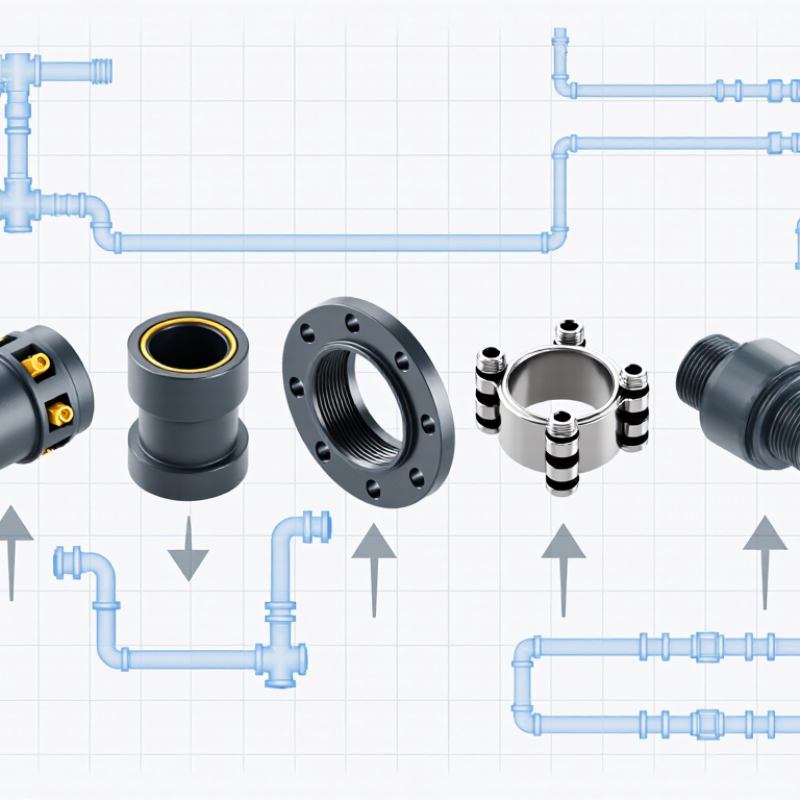
Seven Poly Pipe Fitting Types: PE80/PE100, SDR, and ISO 4427 Ratings
7 Best Poly Pipe Fittings for Global Buyers?
Seven poly pipe fitting types serve different installation needs:
couplers, elbows, tees, reducers, flange adaptors, saddles, and end caps.
Material selection matters. ISO 4427-1:2022 recognizes PE80 and PE100 pressure systems.
ISO 9080 defines their long-term strength through a 50-year design reference.
PE80 has a minimum required strength of 8 MPa. PE100 reaches 10 MPa.
Higher strength does not automatically mean better performance.
Temperature, fluid, and joining quality still control service life.
SDR means the pipe outside diameter divided by wall thickness.
A lower SDR usually provides higher pressure capacity. For example, an SDR11 PE100 pipe commonly supports higher pressure than SDR17.
However, actual ratings depend on temperature and safety coefficients. Buyers should match the fitting SDR with the pipe SDR.
Mixed dimensions create weak transition points.
ISO 4427 also requires compatible dimensions, materials, and test methods.
Small errors can become expensive leaks.
Tips:
Request certificates showing PE grade, SDR, ISO 4427 compliance, and batch traceability.
Check whether the fitting uses electrofusion or butt fusion. Confirm operating temperature and pressure before ordering.
Ask for hydrostatic test data, not only a catalog promise. A clean surface matters greatly.
Even the best fitting can fail after careless scraping, dirty tools, or poor cooling time.
One detail is often missed: reducers and saddles may carry different pressure ratings than straight couplers.
Always review the technical sheet.
Electrofusion Couplers and Saddles: 16–32 bar Systems Under EN 12201
For global buyers, electrofusion couplers and saddles must match the pressure class, pipe SDR, and service temperature.
In 16–32 bar systems, a fitting’s pressure label alone is not enough. EN 12201 provides the framework for polyethylene piping used in water applications, but project specifications still control selection. Check the fitting size, material grade, dimensional compatibility, and approved operating conditions before ordering.
A coupler should provide even fusion around both pipe ends. A saddle needs stable contact, correct outlet dimensions, and reliable branch reinforcement.
Clean the pipe surface carefully. Scrape the oxidation layer evenly, remove dust, and keep the fusion zone dry. Small contamination can create a hidden weak point.
Alignment also matters. A pipe that shifts during heating may produce an attractive joint with poor strength.
Do not rush cooling.
Procurement teams should request batch traceability, fusion data, pressure-test records, and installation guidance. I would also verify whether the stated 16–32 bar rating applies continuously or only under specific temperature conditions. This detail is often overlooked.
A fitting may perform well in a cool test yard but lose capacity in warmer ground. Site technicians need compatible fusion equipment, calibrated electrical output, and enough working space around each joint.
One practical lesson is uncomfortable: the cheapest fitting can become expensive when rework, water loss, or access excavation enters the calculation. Overspecification is not always wise either; unnecessary wall thickness can complicate handling and increase costs.
Butt-Fusion Elbows, Tees, and Reducers: SDR7.4–SDR17 Design Choices
7 Best Poly Pipe Fittings for Global Buyers?
Butt-fusion fittings are practical choices for high-integrity polyethylene pipelines. The main options include 45-degree elbows, 90-degree elbows, equal tees, reducing tees, concentric reducers, eccentric reducers, and flange adaptors. Each fitting changes flow direction, splits a line, or connects different pipe sizes. A 90-degree elbow saves space, but it also creates more turbulence than a longer-radius bend. Equal tees suit balanced branches, while reducing tees simplify compact service connections.
SDR7.4 has a thicker wall than SDR17, so it generally handles higher pressure under comparable conditions. However, pressure ratings also depend on resin grade, operating temperature, design coefficients, and the governing standard. Do not guess. Confirm the pipe and fitting share the same outside diameter and compatible fusion requirements. A reducer must match both pipe sizes precisely. Small dimensional errors can produce uneven beads and weak joints. This detail is often missed.
During site inspections, installers commonly check heating-plate cleanliness, insertion depth, alignment, and cooling time. These steps matter more than attractive packaging. For buried networks, long-radius elbows can reduce stress at bends. For vertical branches, eccentric reducers may help manage drainage and air movement, depending on orientation. Global buyers should request dimensional drawings, pressure data, material certificates, and test records before ordering. One useful reflection remains: the “best” fitting is not universal. Local soil, temperature, pressure cycles, and installation skills can change the correct SDR choice.
Compression, Flanged, and Transition Fittings: DN16–110 mm and PN10–PN16
For global buyers, the best poly pipe fittings must match pressure, diameter, and installation conditions. Compression couplers suit fast repairs across DN16–110 mm lines. Compression elbows help route pipe around tanks, walls, and uneven trenches. Tees divide flow for irrigation or utility branches. Reducers connect different diameters, but they need careful flow checks.
Flanged adaptors create a removable joint for pumps, valves, and meters. Pair them with stub ends and correctly rated backing rings. PN10 fittings work at lower pressure than PN16 fittings, so mixing them without verification is risky. Transition fittings connect polyethylene pipe to metal or threaded systems. They are useful near treatment equipment and older networks. ISO 4427 links polyethylene pressure design with SDR classes, while the Plastics Pipe Institute PE Handbook uses a 50-year design basis for many PE systems.
A practical buying shortlist includes seven types: couplers, elbows, tees, reducers, flanged adaptors, stub-end assemblies, and transition fittings. Check dimensions against ISO 4427 or the project specification. Confirm pressure ratings at the operating temperature. The World Bank’s water-sector reports repeatedly identify leakage reduction as a major efficiency opportunity, making joint quality more important than low purchase price. Field experience also shows that dirt on compression seals causes avoidable failures. I would not approve a fitting from a catalogue image alone. Test records, material certificates, and installation instructions still matter. Some projects need electrofusion instead, so this shortlist is useful, but not perfect.
Global Compliance Checklist: ASTM F2620, NSF/ANSI 61, and Traceability
Choosing the seven best poly pipe fittings starts with compliance, not appearance. ASTM F2620 covers heat-fusion joining for polyethylene pipe and fittings. Buyers should request qualified fusion procedures, heating temperatures, pressure settings, and cooling times. A fitting may look perfect and still contain a weak joint.
NSF/ANSI 61 addresses health effects from materials contacting drinking water. Ask for current certification, scope, and product-size coverage. Do not accept a generic “food safe” statement. The WHO/UNICEF Joint Monitoring Programme reported that 2.2 billion people lacked safely managed drinking water in 2022. That figure raises the cost of poor material control. UNESCO’s 2024 World Water Development Report also states that agriculture uses about 70% of global freshwater withdrawals. Irrigation networks need dependable fittings, especially under repeated pressure changes.
Tips: Build a traceability file for every shipment. Record resin batch, fitting size, SDR, production date, operator, machine number, and inspection results. Keep photographs of labels and fusion beads. Confirm pressure ratings against the full system design, not one fitting alone. Field audits often uncover missing batch records. Small detail. Big risk. I would also verify local approval requirements, because ASTM and NSF acceptance may not cover every destination. A checklist helps, but it is not proof of quality by itself.
7 Best Poly Pipe Fittings for Global Buyers
Global Compliance Checklist: ASTM F2620, NSF/ANSI 61, and Traceability
Checklist indicator: 1 means the requirement or verification step is relevant for the fitting and intended service; 0 means ASTM F2620 is not the applicable joining route. NSF/ANSI 61 should be verified for components used in drinking-water contact, while traceability should cover material grade, production batch, dimensions, and test records. Electrofusion products generally require an applicable electrofusion joining procedure rather than ASTM F2620.